Peoria
Broken Rejected MatePeoria is presented as a place of attempted normalcy rather than uncomplicated safety. Sierra Langford moves there with her father while they remain under the threat posed by her Dysomnia nature, and the town becomes the setting in which school, friendship, romance, pack politics, and inherited persecution converge. Its decisive significance lies in the contradiction it embodies: Peoria offers Sierra the possibility of an ordinary life, yet its proximity to the powerful Blue Blood Pack makes concealment more difficult and danger more immediate.
Arrival and Concealed Danger
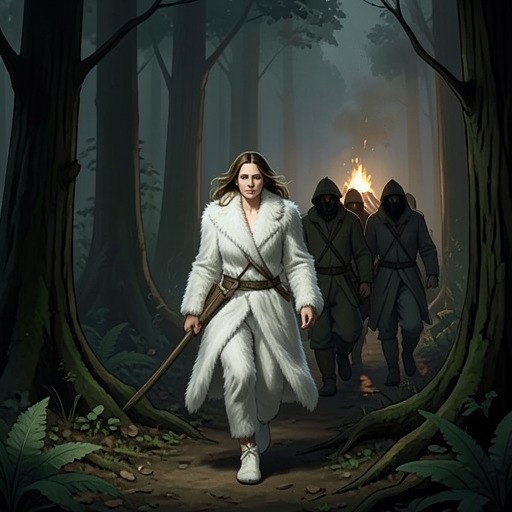
Sierra identifies herself as seventeen years old and newly moved to Peoria with her father. The move does not end the habits formed by a lifetime of flight. She has never felt completely safe, and even the small house can make her feel claustrophobic; when she goes outside to take out the trash, the cool night air briefly calms her anxiety before a low growl announces that danger has followed her there.
The threat appears in the form of huge black Alsatian dogs, foaming at the mouth and quietly growling. Sierra senses not only their anger but also their fear of her, an instinctive response to what they perceive as dangerous and different. When one dog leaps, her father arrives in another animal form and throws it back, reinforcing that Peoria is not a neutral refuge. Even at home, Sierra's presence can provoke violence, and her father's protection also reminds her how dependent their survival remains on constant vigilance.
Her father's warning gives the town a wider geographical and political meaning. Peoria lies within the territory of the largest pack in Arizona, and Sierra and her father will be living beside that pack and therefore on its radar. He knows little about the Blue Blood Pack beyond its strength, power, and ruthlessness, so he instructs Sierra to keep her head down and avoid drawing attention throughout their stay. Peoria is thus a place of concealment bounded by surveillance: the town may look ordinary, but its supernatural population makes every exposure potentially consequential.
Domina High and the Performance of Normality
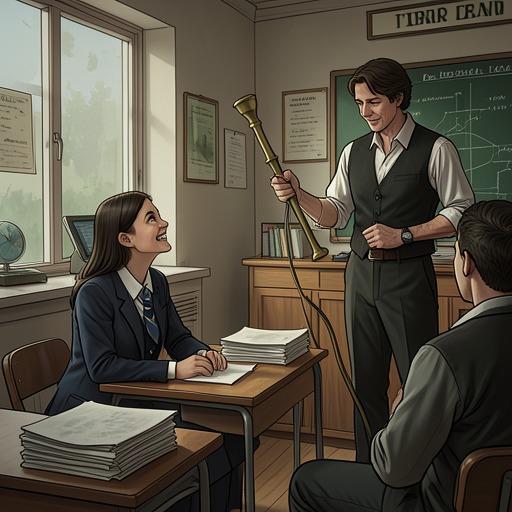
Domina High is a fairly small school, with fewer than a thousand students, precisely the kind of environment Sierra would prefer to avoid. She wants to blend into the background, but the limited student population makes her arrival conspicuous. Students notice the new girl, ask questions, and circulate points and whispers before she has established any identity beyond being unfamiliar. The school cannot provide true anonymity, yet it gives her a recognizable routine and a temporary sense of normal life.
Sierra enters her final year as a senior, only months away from graduation and her eighteenth birthday. That birthday carries more than ordinary adolescent significance because it brings the danger she fears closer to the surface. The school year therefore becomes a countdown: every classroom and cafeteria encounter takes place against the approaching threat of her fuller identity becoming harder to hide.
At Domina High, Sierra repeatedly has to perform sociability. In Biology, the teacher calls her to the front and asks her to introduce herself, forcing her to state that she is Sierra Langford, seventeen years old, and has just moved to Peoria with her father. The polite applause and her hurried return to her seat reduce a deeply guarded life to a few harmless facts. The scene captures the strain of her new setting: ordinary rituals are available to her, but participation requires controlled disclosure.
At lunchtime, she deliberately enters the cafeteria despite hating the school's smallness and knowing that everyone already seems aware of her presence. She initially intends to make an effort when approached rather than remain entirely cold and aloof, and she later returns to Alan Lowell's table partly to provoke Tony and partly because she is curious about Alan. The cafeteria becomes the first social arena in which Peoria's promise of belonging begins to compete with Sierra's instinct to remain invisible.
The Town as a Threshold to Connection
Alan Lowell encourages Sierra to give Peoria a chance, arguing that she might not hate the town if she tried to enjoy her stay. Sierra agrees mainly to make him leave, but the exchange marks a shift in how Peoria functions for her. It is no longer only the place where she must hide; it becomes a place another person asks her to inhabit, even briefly, on terms other than fear.
Her attraction to Alan complicates the precautions imposed by her father. Sierra suspects that Alan may be a werewolf and knows that, if he is, she ought to stay away from him. At the same time, she hopes he is not, because she regards him as one of the best people she has met in a long time. When Alan sits close beside her at lunch, his scent of cologne and pine needles and his dazzling smile produce feelings she does not understand. Peoria therefore initiates a conflict between inherited survival knowledge and the possibility of attachment.
Sierra's presence at the table gradually becomes a repeated social arrangement. Alan accepts her without hesitation, while Tony watches her with open hostility from the far end. The scene places her between welcome and suspicion, anticipating the larger division between those who can see her as a person and those who understand her primarily through the category of Dysomnia. The town's social spaces make that division visible before its full supernatural implications are revealed.
Peoria Within Dysomnia History and Pack Politics
The town's danger cannot be separated from the history Sierra carries into it. Her father explains that Dysomnias were once revered for strength and intelligence and may even have been treated as a form of wolf royalty. That status was destroyed when Dysomnia wolves became feral, hunted other werewolves, and killed without reason. The surviving wolf communities now hunt them because they fear a repetition of that history, while only about twenty Dysomnias are believed to remain in the entire world.
Sierra's family history makes Peoria part of a much older pattern of exclusion. Her mother was identified as different from birth, initially protected by her alpha father, and later loved by her pack despite their hope that she would not become a Dysomnia. During her first shift, however, she killed two pack members. The pack turned against her, and she was killed immediately after giving birth to Sierra, while Sierra's father fled with the child. Their life on the run is therefore not a temporary inconvenience but the direct consequence of a persecuted bloodline, and Peoria is another test of whether that bloodline can remain concealed.
The school and town also sit close to the Blue Blood Pack's succession crisis. Pack members explain that, when several Alpha contenders arise, ordinary custom would require a fight to the death to determine the strongest. Later, with the pack lacking an Alpha and Anthony Lowell having no desire to assume the position, the elders turn to Alan Lowell as the only other wolf among them with Alpha blood. More than a hundred pack members gather to hear the proposal, and Alan is described as strong, courageous, merciful, and fair, with a powerful mate who could help form a formidable Alpha pair. Peoria thus becomes linked not only to Sierra's private concealment but also to the institutional future of the pack beside which she is living.
From Temporary Residence to Future Home
Peoria's role changes as Sierra's relationships deepen. What begins as a place where she is told to remain unnoticed becomes the setting for her involvement with Alan Lowell and the Blue Blood Pack's political future. Her identity is repeatedly at risk of exposure: a green-eyed boy named Charlie recognizes her as the girl who killed a hunter, showing that events connected with her have already entered the community's knowledge.
The town's future significance extends beyond the first stage of Sierra and Alan's relationship. Tony Lowell eventually seeks his mate after a witch partially unblocks his vision of her, even though the vision remains faint and confusing. That search, together with the pack's deliberations over leadership, shows Peoria as a crossroads where mate bonds, family continuity, and political succession intersect rather than remain separate concerns.
By the later course of the story, Sierra and Alan are no longer merely trying to survive in Peoria. They decide to try to have a baby, despite their earlier fear of how to raise a Dysomnian child born with Alpha blood. Their confidence comes from being together and from seeing Tony Lowell and Caroline raise their twins successfully. The pregnancy test Sierra brings home transforms the meaning of the town once more: Peoria has become associated not only with concealment and danger, but with the possibility of family, continuity, and a future in which the persecuted bloodline is protected rather than erased.